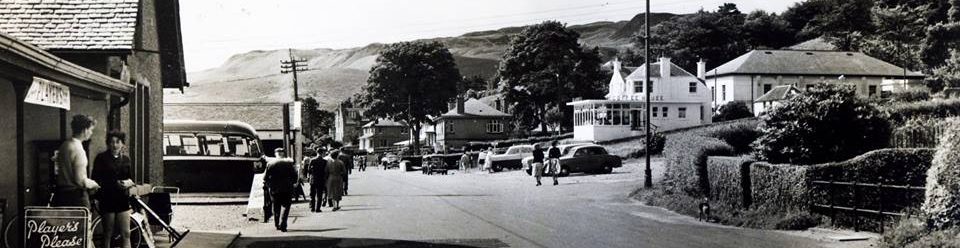
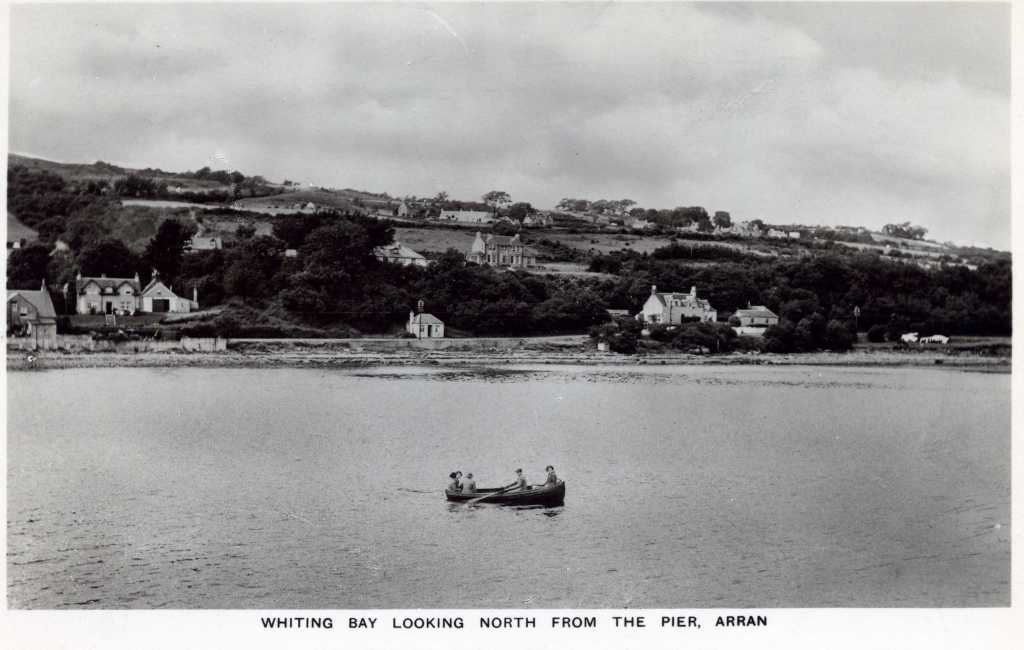
Look to the left of this image and you will see a large white building with dark double doors. This is the bottom of Smiddy Brae. It is here that our story begins in 1850.
This story was found by researching British Newspaper Archives for Whiting Bay Memories. The story grew and it is now possible to connect the families to the growing village family tree.
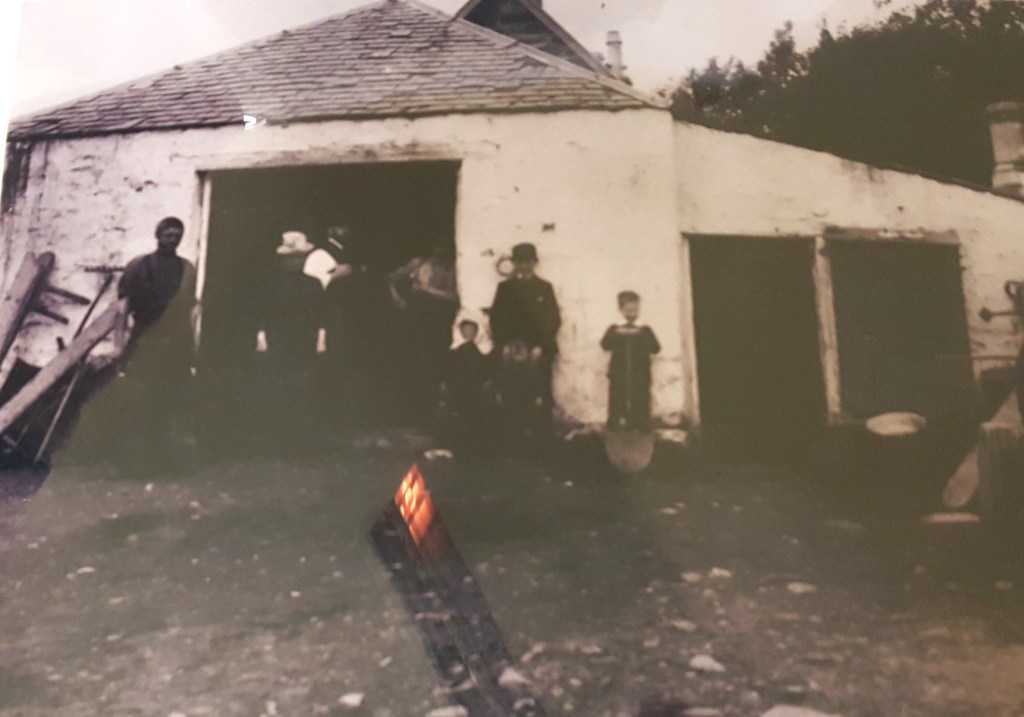
Glasgow Gazette – Saturday 26 October 1850
Arran—Supper and Presentation.
“On Tuesday night last, a few friends of Mr. James Cook, met in Mr. McKinnon’s Inn. for the purpose presenting him with a splendid silver watch and guard, as a token of esteem for his unremitting and gratuitous services rendered to the inhabitants of Whiting Bay and Lamlash, and the other districts of Arran, as a farrier, as well his usefulness as a blacksmith. The chair was occupied Mr. Alex. McNish, LamIash; and Mr. Andrew Watt, Paisley, acted croupier. The chairman, in a neat and appropriate speech, passed well merited eulogium on James Cook ; to which he feelingly replied.
The watch was purchased from Mr. Daniel Duff, watch and clock-maker, Paisley. The night was spent in a very agreeable manner. It needless to mention that the supper, etc., provided by our host, were served in his usual good style.”
A Melancholy Tale
Hampshire Advertiser – Saturday 28 October 1865
PAINFUL INCIDENTS OF A FATAL BOAT ACCIDENT.
“A melancholy boat accident occurred off Holy Isle on Tuesday in last week, whereby three persons perished.
The following details relative to the unfortunate accident given by a survivor are published in the Glasgow Herald.
The smack Ann, of Whiting Bay, belonging to two brothers named Stewart, left Whiting Bay early on Tuesday morning for Ayr. The smack had been chartered by Mr. Cook blacksmith, Whiting Bay, for the purpose of going to Ayr in order to bring back coal, iron, and other stores purchased in that town to be used during the winter. Mr. Cook and his daughter accompanied the brothers as passengers The smack left Ayr harbour on Tuesday afternoon on the return voyage, laden with coal, timber, iron.
4 o’clock The weather was very boisterous, but no danger was apprehended. Another smack, manned by a cousin of the Stewarts, named Mathie, also left Ayr harbour at the same time, and continued to keep a short distance astern of the Ann until the accident happened. As the vessels were nearing Holy Isle a violent squall suddenly struck the Ann, which caused her to capsize immediately the smack heeling over and remaining keel uppermost. Of course, the voyagers were thrown into the sea. When Capt. Mathie perceived the acci- dent, he immediately bore down upon them, and threw a rope, in the hope that some of the immersed persons might be able to seize it. The rope fell short, however; and as the storm increased in violence, and there being only another man on board the smack with Mathie, whose hand had been injured, Captain Mathie found himself unable to render further assistance, and was obliged to make for the land. When Mathie left the capsized smack the four persons were clinging to it, and loudly calling for assistance.
What followed may be shortly told. Cook and his daughter, and the two brothers Stewart, all got upon the lee side of the capsized smack. In this position every wave broke over the upturned boat, and dashed against their faces, blinding them with spray and benumbing them with cold. This soon began to tell upon their strength. Miss Cook was the first to succumb.
After clinging to the bottom of the boat for about an hour she bade her father farewell, and shortly thereafter letting go her hold, she fell into the water and soon disappeared.
Night was now fast approaching, and as yet no help was nigh. The sea was very tempestuous ; and as every wave continued to wash over the individuals, it soon became apparent that the three men must also sooner or later succumb, unless deliverance should speedily be sent them. The upturned boat was drifting out to sea ; and as they were far from land there was little prospect of their being soon thrown ashore. Some hours after Miss Cook fell from the wreck the strength of the elder brother Stewart began to fail, and he soon thereafter bade his companions farewell, and fell off the bottom of the vessel into the sea. A wave, however, washed him back again, when his brother seized hold of him and endeavoured to strengthen and encourage him by cheering remarks but being unconscious he failed to be roused, and after holding him, about an hour on the wreck, this faithful brother was obliged to let his unconscious relative drop into the seething billows, where he perished. Mr. Cook and the surviving Stewart were now left together. Darkness had fallen upon them, and the storm raged as violently as before. As the waves continued to dash upon his face, Stewart managed to climb over the upturned boat, and got his back to the wind. Finding his position improved by the change, he requested Cook to come over, but strength failed him, and fearing to lose his hold, he clung tenaciously to his place. Towards midnight Mr. Cook’s strength at length began to fail, and he too soon fell from the boat and perished. The young ‘man* Stewart was now left alone, and all night he was tossed about on the open sea, clinging to the keel of the upturned boat.
During his lonely voyage, however, he found a piece of rope floating near the wreck, with which he lashed himself to the bottom of the boat. Daylight at last broke, and still no help was near. As the morning advanced hope began to leave him, and, in the agony of despair he was about to resign himself to his fate, when he espied a vessel bearing down upon him. The vessel proved to be an outward-bound schooner; her name we were unable to learn. She had taken shelter in Lamlash Bay during Tuesday and proceeded early on Wednesday morning. A rope was thrown from the schooner to Stewart, which he seized. He then took his knife out of his pocket, and having cut the rope by which he was made fast to the wreck he was dragged alongside the schooner and taken on board, where every kindness was shown to him.
He was conveyed to Portpatrick, on the Galloway coast, and landed there, and was subsequently forwarded to Arran by the Shipwrecked Mariners’ Society, and arrived on Saturday. When he reached his father’s house the feelings of his parents may be imagined. All hope of the escape of any of the unfortunate passengers or crew had been banished from their minds, and his appearance in their midst alive could not be fully realised for some time. Mr. Cook has left a widow and family. We had omitted to mention that Stewart was picked up near Ailsa Craig. His escape was a most miraculous one. Stewart was about eighteen hours exposed to the cold and fury of the wind. The survivor attributes his preservation to his getting to the windward of the upturned vessel, by which means he was better able to cling to the wreck.”
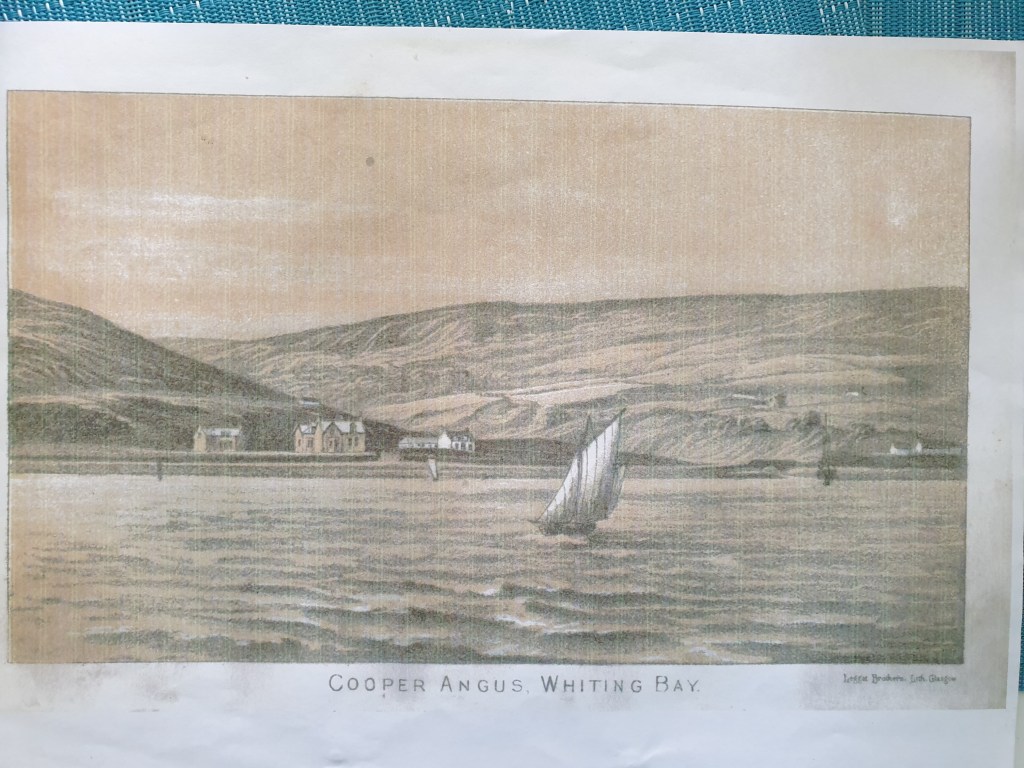
Dundee Courier – Thursday 26 October 1865
“The Boat Accident off the Holy Isle
The name of the schooner which rescued James Stewart from the wreck of the Ann, off Ailsa Craig, was the Duke of Runcorn ; while the name of those drowned were Charles Stewart, and James Cook, blacksmith, Whiting Bay, with the daughter of the latter.”
Paisley Herald and Renfrewshire Advertiser – Saturday 04 November 1865
Public Notices.
“Subscriptions in aid of Mrs Cook, Whiting Bay. Arran, whose Husband and Daughter were lost to the late Gale, leaving her utterly destitute. As the old Smith must be well known to Visitors in Arran, any Contributions towards the support of his unfortunate Widow will be thankfully received by MR. ROBERT WIXGATE, Coffee Room. JAMES CLARK, Camphill, Treasurer. Paisley, 26th October, 1865.”
It is clear from the first report that James Cook Blacksmith was a well respected man and valued member of the community. The void was filled by Neil Currie Blacksmith. Read on ….
Irvine Times – Friday 03 July 1885
FATAL BOATING ACCIDENT AT WHITING BAY, ARRAN.
“On Wednesday afternoon, a fatal boating accident occurred at Whiting Bay, resulting in the death of one man and the narrow escape of his three companions. A party of four men, named James McGregor, owner of the boat; James Stewart, David Kerr, and Neil Currie, Blacksmith—all belonging to Whiting Bay—went out on Wednesday afternoon for a sail in the bay.
They had only been out for a short time and were about half a mile from the shore when the boat was observed to go down stern first. Three young lads, who were also out boating at the time, and who saw the accident occur, immediately rowed to the assistance of the four unfortunate men.
On reaching the spot, Stewart and Kerr were found keeping themselves afloat by swimming about, but McGregor and Currie were found floating in an unconscious condition. They were speedily brought ashore, and every means employed to restore them to consciousness. Eventually McGregor recovered, and is now doing well, but the man Currie never rallied. The melancholy occurrence has cast a deep gloom over the neighbourhood, where the unfortunate man was well known.
He was a widower and leaves a large family of young children. The cause of the accident has not yet been clearly explained. It appears, how. ever, to have arisen through carelessness in the management of the boat.”
20 years after the loss of James Cook, Whiting Bay lost another Blacksmith and a young family lost their father to the sea.
Ayrshire Weekly News and Galloway Press – Saturday 26 September 1885
“NOTICE ALL Parties having CLAIMS against the
late NEIL CURRIE, Blacksmith, Whiting Bay, are requested to Lodge them, and all Parties INDEBTED to to the Deceased are requested to Make Payment, before 15th October, to the subscriber, PETER DOWNIE. Whiting Bay Public School, Arran, 22nd September 1885″
It would have been nice if the search revealed some good news for our tale, but sadly this was not to be. Read on …
Glasgow Evening Citizen – Friday 01 February 1889
“At Penzance, near St. Ives, Cornwall.
James Stewart, Whiting Bay. Arran, was accidentally drowned.
It is a singular circumstance that Stewart formed one of the boating party upset at Whiting Bay some time ago. when one of the men was drowned.”
Our next Blacksmith has a familiar name. This next record is his death notice and that is followed by an account of what happened to his son.
Ardrossan and Saltcoats Herald – Friday 30 March 1888
TAYLOR—At Whiting Bay, Arran, on the 19th inst., Alexander Taylor, blacksmith, aged 64 years, formerly of Holmbyre Smithy, Dalry.
Edinburgh Evening News – Wednesday 28 December 1898
“BANKRUPTCY PROCEEDINGS. SCOTTISH.
(From last night’s “Edinburgh Gazette.”) PETITIONS FOR CESSIO
John Taylor, Blacksmith, Whiting Bay, Arran.”
Now for some good news. The family survived and prospered. Many of you will remember them and have your own tales to tell.
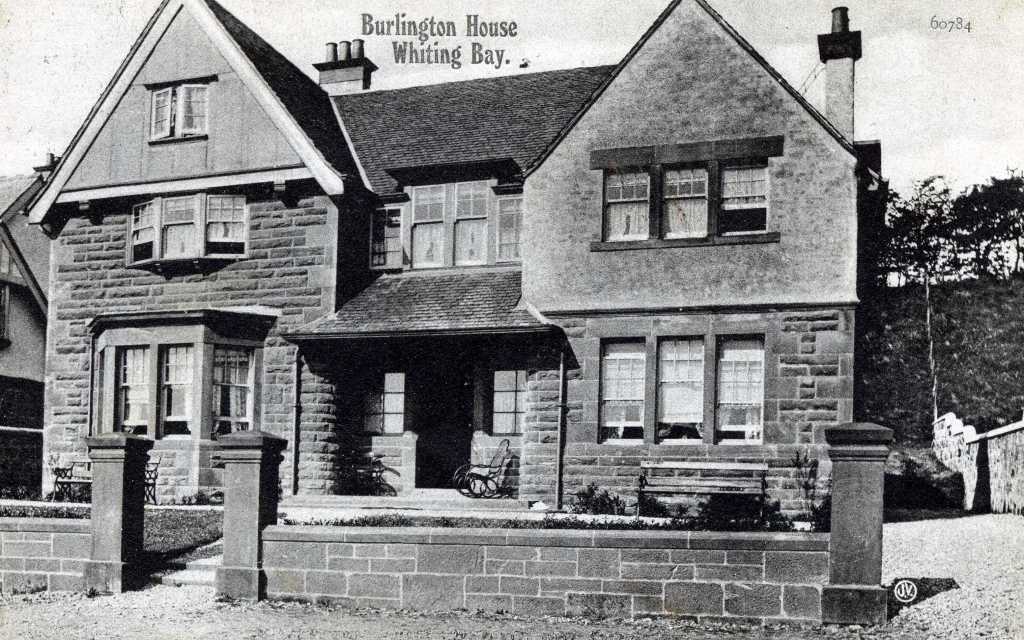
Our genealogy research has identifed that James Stewart who was the only survivor of the smack Ann was from Largymore. His parents were Robert Stuart (Stewart or Stuart would depend on the writer) and Elizabeth Mathie born Knockenkelly. Captain Mathie who had to leave the stricken vessel Ann was also from the same Knockenkelly Mathie family. It must have been very traumatic for all the family involved. Losing both sons was terrible.
The Stuart/Mathie family from Largiemore also connect to James Stuart who built Mirimar and Milverton and Argentine. For anyone who studies our website and our facebook group, the Stuarts also connect to the Grieves Family, hence the road up from the Coffee Pot now being called Grieves Road. It was previously referred to as Golf Course Road.
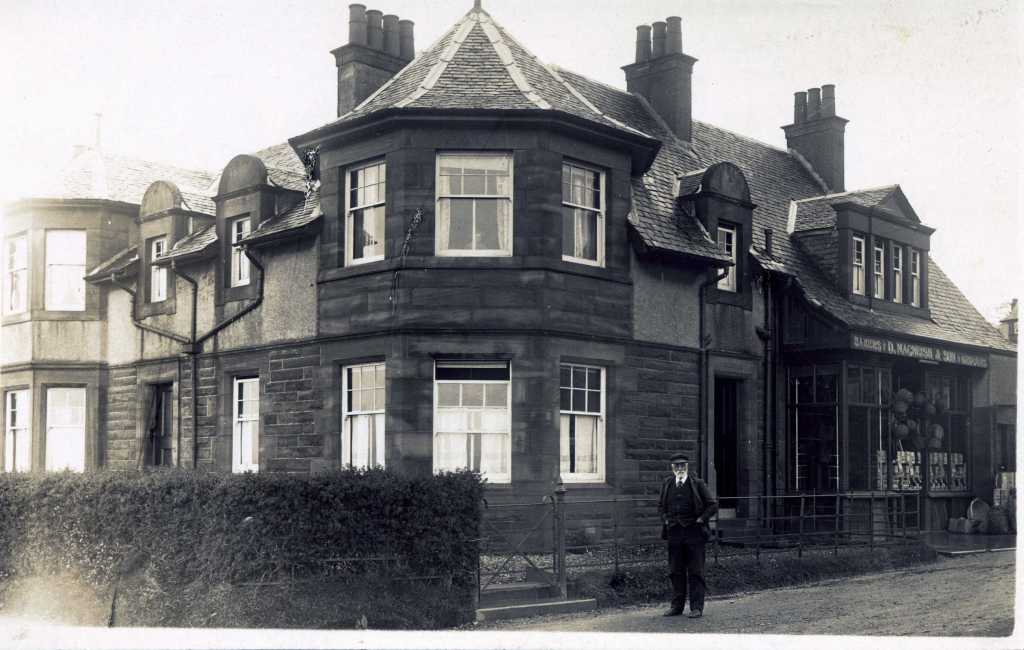
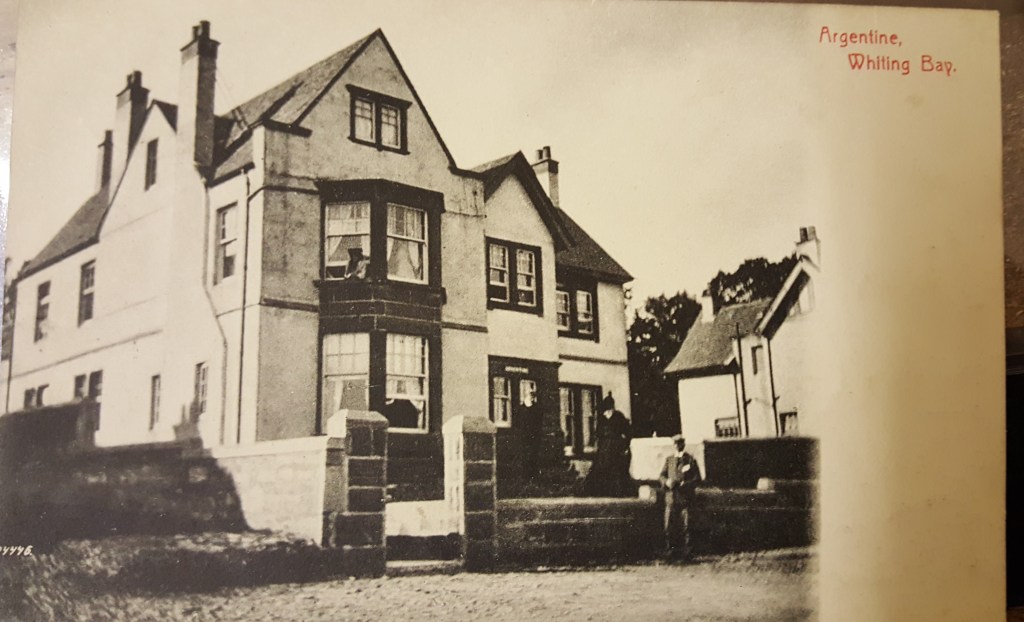
Captain James Stewart who survived the Whitng Bay accident but drowned in Cornwall was son of Captain Andrew Stewart nephew of The Rev. Angus Stewart.
Rev Angus Stewart was minister of the Free Church for 25 years, The Church at Sandbraes was originally called “The Angus Stewart Memorial Church”
The family had been cleared from Catacol and moved to farm land in North Kiscadale. Bourtree Bank was the first Stewart home.
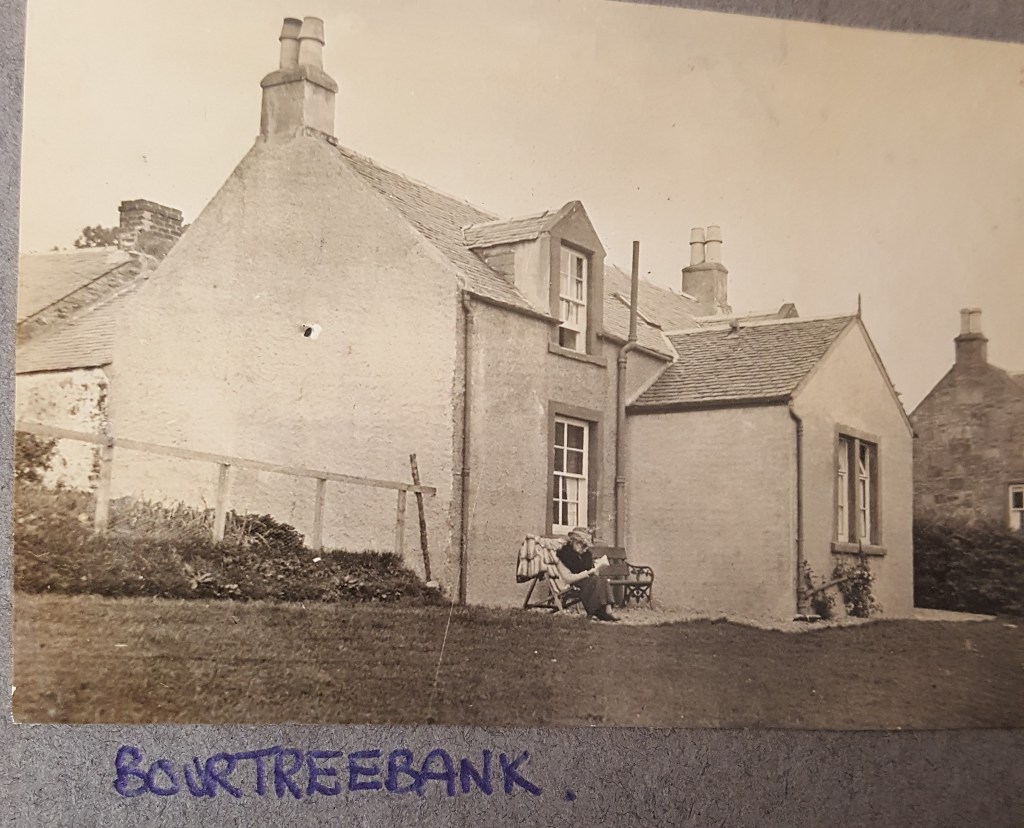
A Story researched by Whiting Bay Memories for the Heritage Tales and Trails Project.
 Whiting Bay Memories