Sharing history and your memories of Whiting Bay on the beautiful the Isle of Arran
Largiemeanoch Memoirs
Extracts from written memories of Norman M Bowman (1912-2012).
contributed by Norrie Bowman (pages 19-21)
Here is an extract from my late father’s memoirs, giving a glimpse of a different age!
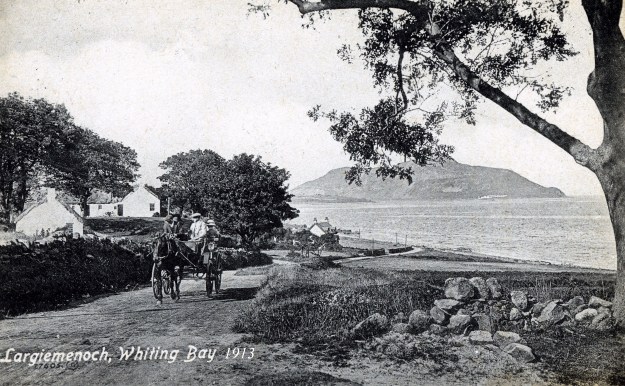
Our Arran holidays also gave us a personal familiarity with a number of the Clyde steamers serving the Arran piers. Besides the Ardrossan based steamers, Sannox, Atalanta, and in the winter, Glen Rosa, the turbine Duchess of Argyll called daily before returning to Gourock; the Williamson paddler “Queen Empress” came on cruises twice a week, and the bonny broad beamed Juno appeared from Ayr once a week. There was some anger when the popular Glen Sannox appeared, in 1923, in the unfamiliar and far from beautiful livery of the L.M.S., formed by an amalgamation which ended the rivalry between the Caledonian S.P.C. and the G.& S.W. steamers. And there was sheer distress when she finally disappeared after the 1924 season to be replaced with a two funnelled turbine, sister to the Duchess of Argyll, which carried on the name. It was on this new Glen Sannox that many of my subsequent journeys to and from Arran were made. When I first began to enjoy “lifts” on the Arran roads it was not of course on a motor car but on a horse drawn brake. There was an art in mounting and descending from the back step of such vehicles, which I learned the hard way – by falling on my back if I tried to leave without facing the way in which the brake was travelling. The clearest memory of the horse drawn days concerns a grumpy driver whom we christened “the man with the green jacket”. Sitting primly in his brake one day with other passengers, I was watching the great rear wheel turning on its spindle. As we approached Mentone, the last house before Braehead, I saw that the wheel was sliding out and in along the greasy shaft. Young as I was, I felt certain this was not as it should be. Plucking up courage I tapped the driver on the shoulder and asked him if the wheel was behaving properly. To my amazement he stopped the wagon in a blazing temper, hurling abuse at me for not telling him sooner! “The horse would have kicked the lot to splinters if that had come off!” he shouted.
Mentone
For many years of my childhood, my family, together with a few other ‘regulars’ met on the platform of Saltcoats North Station – in those days the station of the old Caledonian Railway – surrounded by children and cases and ‘the hamper’ in which most of the holiday clothes and linen were packed. We found our places in a train already busy with holiday makers from Glasgow and Edinburgh, for the train left Central Station and was therefore convenient for those coming from the East. At Montgomery Pier we boarded the Caledonian steamer – although, in fact, as a result of a working arrangement between the G & S.W. and the Caledonian Steam Packet Company, this run was undertaken by the Atlanta, a turbine in G & S.W. colours, from her return from war service in 1919 until she was replaced by the Marchioness of Graham in 1936. She was not a fast vessel and rolled a great deal unless the sea was smooth. Loading of luggage on the first of the month delayed steamer departures and we had plenty of time to watch the magnificent paddler Glen Sannox loading at her berth across at Winton Pier. Because of convenience at the Saltcoats end we usually travelled by the Montgomery Pier connection but I always hankered after a voyage on the Sannox – the pride of the Clyde and its fastest ‘flier’. This longing was sometimes satisfied by a sail between the Arran piers during the summer.
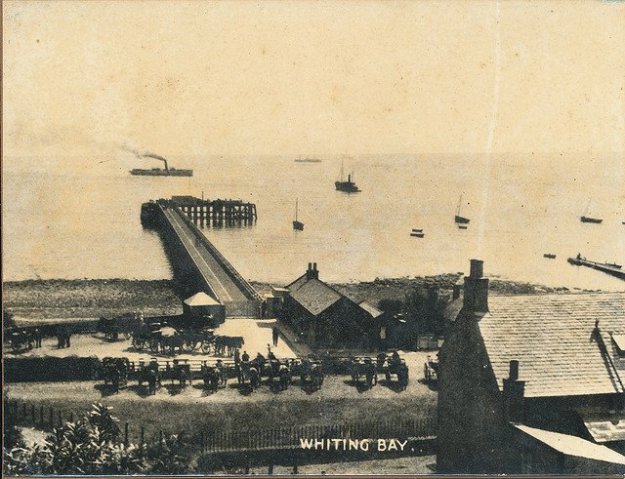
Whiting Bay pier was very long and heavy luggage was left to be collected by someone with horse and cart (later, motor lorry). This was Papa’s chief concern and it was always a matter of pride with him if our luggage arrived at our holiday home within an hour or so. We travelled in the early days by horse-drawn ‘brake’ and later by a car hired at the pier from William McNeill, the jovial proprietor of Breadalbane Boarding House in Kildonan.
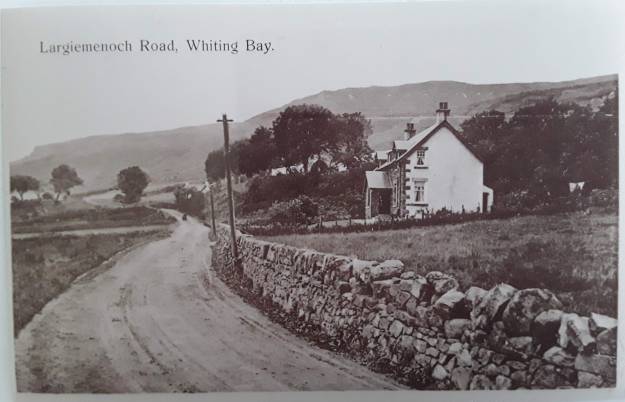
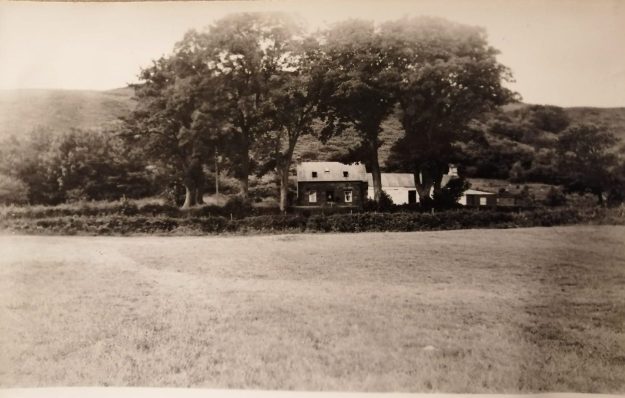
Norrie Bowman Contributed Largiemeanoch Image
The earliest Arran house that I remember was the thatched white cottage at Braehead, property of Finlay McNeill, whose formidable daughter gave me the first demonstration that I remember in the art of milking cows. Where we all slept was something of a mystery. The cottage was basically a but and ben with a small bedroom between. The ‘ben’ or parlour had a small window back and front; a horse-hair sofa on which I remember jagging my bare legs and above the mantlepiece a large flyblown print of, I think, a stag at bay. Facilities were primitive; water was collected from a large tub into which a small stream was directed by a piece of rhone pipe. The constant overflow kept the surrounding flagstones wet and slippery besides encouraging a luxuriant growth of nettles, into which I once fell while collecting a pailful of water.
Hygiene was catered for by a small dry closet set up on the hill about a hundred yards behind the house. My only recollection of Uncle Bob (Fulton) is connected with a summer holiday at this cottage. He played a game involving bat and ball with us children. I presume it was to this house that the family went in the years following the first World War, and always for the month of August.
My clearest recollections, however, are at the cottage called ‘Largiemeanoch’, a quarter of a mile south of Braehead and the property, at that time, of a couple called McKirdy. Their daughter, Bella, was Mrs Sandy Hamilton of Drumla Boarding House at Kildonan, and she will figure in our tale again.
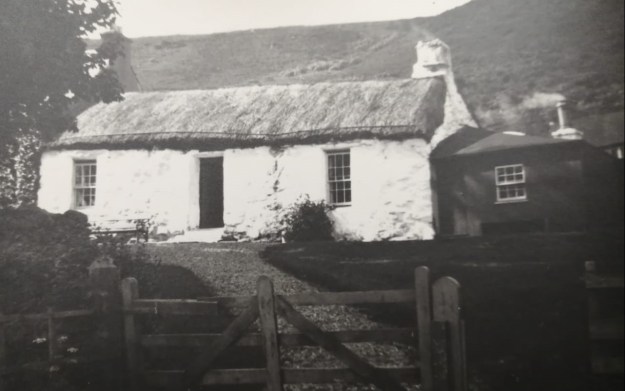
At Largiemeanoch there was a red sandstone house, slated, which McKirdy had built himself with stone from the shore, I believe. Alongside it was a white thatched cottage similar to that at Braehead but I think a little larger and in better condition. At the other end of that the old folks had built for themselves a timber ‘lean-to’ in which they spent the summer, in typical Arran fashion, while the two houses were let to summer visitors. Although separated from the seashore by the road and two sloping fields, as distinct from Braehead, which was practically on the shore, it was an ideal place for youngsters. The hill rose steeply behind the house then levelled off into a bracken-covered plateau before soaring up again to form the ‘Shepherd’s Peak’ as we learned to call it, though I have never found the name on any map. For young limbs it was an easy climb, rewarded by a magnificent view, and from which at evening or in the morning I so often watched the two red funnels of the Glen Sannox come round King’s Cross Point from Lamlash; the sound of the paddles in the evening air is part of the cherished memories of Arran.
Norrie Bowman Contributed Largiemeanoch Image
We made our own fun. In company with the Johnstones, our cousins, and Grandpa Fulton, who usually stayed with them at Wishart’s collection of little huts, just this side of Braehead. Grandpa was still bathing in the Firth of Clyde there in his 79th year. The process was leisurely and took up most of the morning, although actual immersion in the chill morning was not itself protracted. Pools of water amongst the rocks provided ample opportunity for sailing little boats – usually of our own making. I was particularly proud of my first representation of a paddle steamer, which was accomplished by the simple device of halving a cork from a bottle and fitting each half to the sides of a whittled bit of wood (the hull) which already carried two funnels and a mast. The Glen Sannox, in fact, to our imagination. Largiebeg Point had the added attraction of a hillock and caves and sheltered rockpools of better dimensions. There Bertie and I one summer siled the only clockwork motorboat I remember taking to Arran.
One annual treat, repeated for many years, was the visit to Cook’s Stores in Kildonan. I think we all walked at least to Kildonan although it must have been quite a weary step for little ones. An annex to the store was simply furnished as a tearoom and there we partook of the ice cream which was the gastronomic element of the trip.
For a number of years the ‘stone’ house next door was occupied by a family from Kilmarnock – William, Andy and Jenny Armour, none of them married. In poor weather or on late August evenings, we would be invited to join them in simple games of cards, using small aromatic sweeties as ‘stakes’. Andy ran a garage at Riccerton in Kilmarnock and was therefore a man of importance to me, as my interest in motor cars grew.
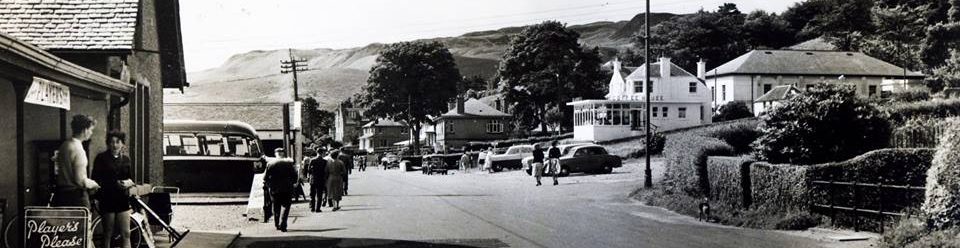
Cars were always a big part of the Arran holiday for me. There were no buses as we understand them then. Willie McNeill, the most enterprising man at the South end at that time, ran a fleet of old Fiat touring cars in connection with his boarding house and two Fiat open charabancs. These were replaced later I remember by two Rolls Royce open charabancs, in chromium and cream; pre-1914 manufacture, I believe, and requiring the aid of a short step-ladder to get into the seat immediately above the rear axle; but a mechanical wonder to me as the driver once started the vehicle from stationary ie without revolving it either by hand or starter, simply by moving swiftly the ignition timing control mounted on the steering wheel. The cylinders must have been very gas-tight to hold a mixture ready to explode. The prevailing car for a while was the Fiat; it may have had something to do with Italian war reparations. The Model T Ford appeared in the form of lorries and Sandy Hamilton’s tonneau which passengers entered from the back and then sat facing each other on bench seats running the length of each side. Poor Sandy was really a horse man and had never come to terms with the motor car; he couldn’t drive himself and had to depend on hired drivers. His heavily jowled, unsmiling face and lumbering gait contrasted unfortunately with Willie McNeill’s genial welcoming smile for everybody.
Whiting Bay Memories group would like to thank Norrie Bowman for allowing us to share his father’s wonderful reflections of times gone by, and a very special piece of social history.
First shown in Whiting Bay Memories 2017 exhibition.
Written By Norman M Bowman (1912-2012).
Contributed by Norrie Bowman
Transcribed by Cheryl Burgess for Whiting Bay Memories
Presented by Whiting Bay Memories
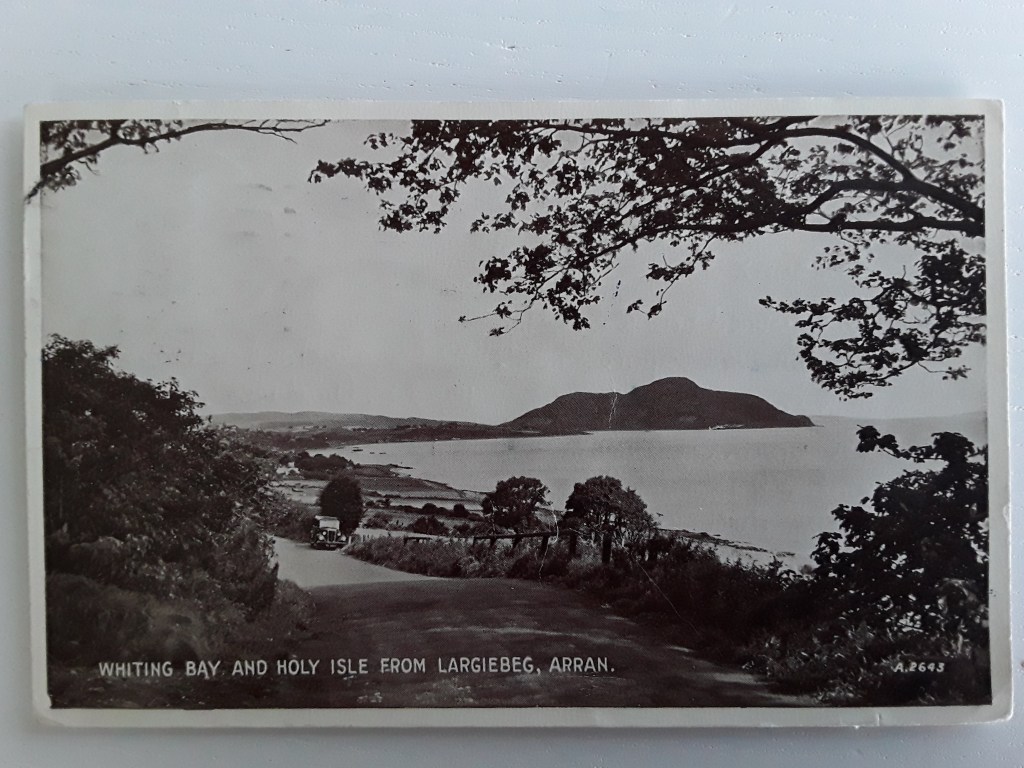
Additional images contributed by members of Whiting Bay Memories

 Whiting Bay Memories